
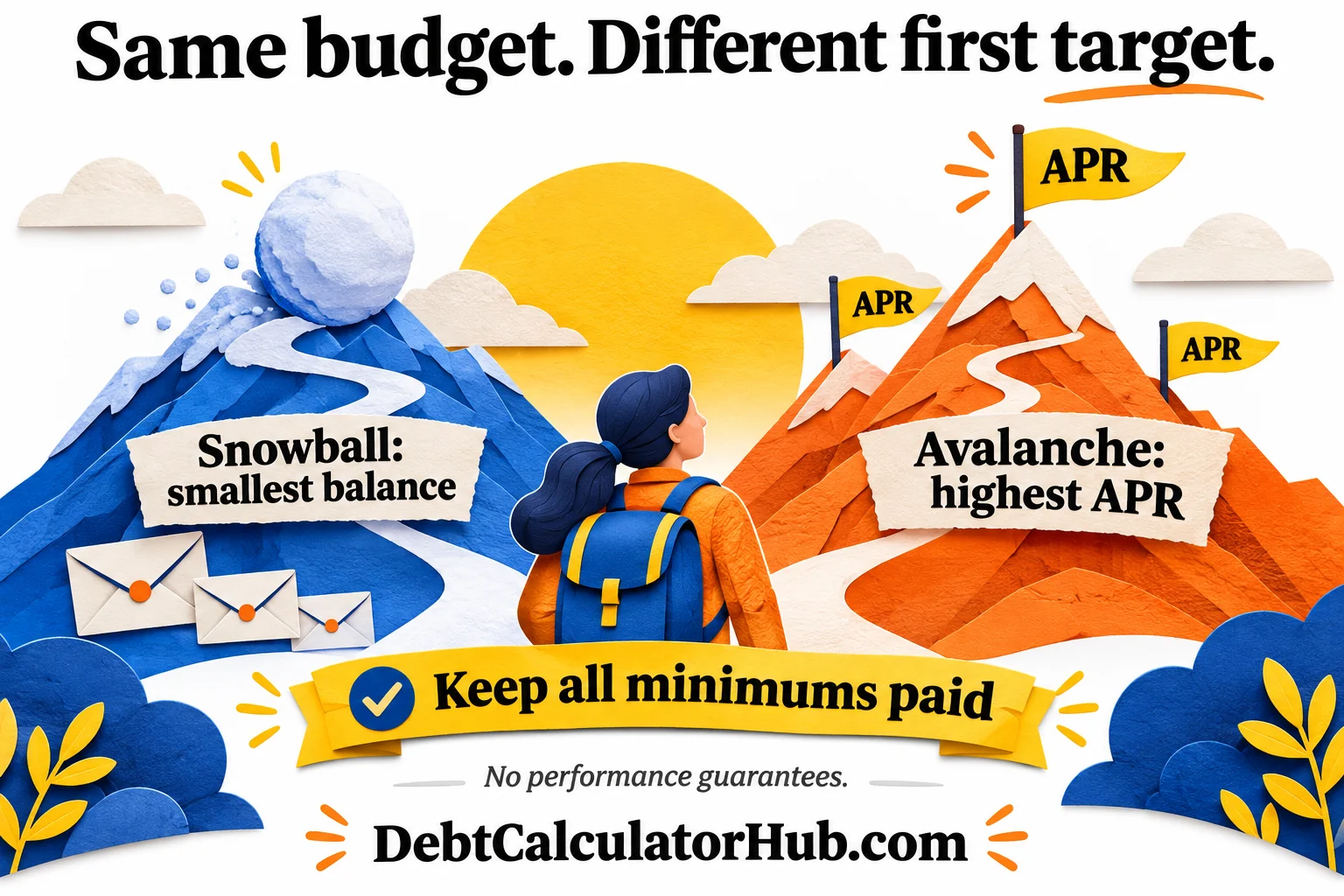
How the avalanche method works
What is the debt avalanche method?
The debt avalanche method is a payoff strategy that targets the most expensive debt first. You list your debts by annual percentage rate, from the highest interest rate to the lowest interest rate. You continue making the minimum payment on every debt, then send any extra monthly payment to the debt with the highest APR. When that debt is paid off, its payment rolls into the next-highest APR debt.
At the same balance, a higher APR adds more interest per dollar owed. A credit card at 27 percent APR can add interest much more aggressively than a personal loan at 9 percent APR. By reducing the highest-rate balance earlier, less interest accrues over time, which can lower the total cost of becoming debt-free.
The avalanche method is often compared with the snowball method. Snowball starts with the smallest balance first, which can create quick wins and motivation. Avalanche starts with the highest rate first, which is usually better for minimizing interest. In simple terms: snowball can feel easier emotionally, while avalanche is usually stronger mathematically.
To use this calculator, enter each debt name, current balance, interest rate, and minimum monthly payment. Add any extra monthly payment you can reliably afford. The calculator estimates interest month by month, pays minimums on active debts, and applies the remaining payoff budget to the highest APR balance until all debts are paid off.
This approach works best when you can stay motivated without needing the smallest debt to disappear first. If your main goal is reducing total cost, the highest-interest balance is usually the best first target because every dollar paid there can prevent more future interest.
Use the results as an educational estimate, not a lender payoff quote. Your real payoff date can change if interest is calculated daily, fees are added, promotional rates expire, or your minimum payments change. Still, this calculator gives a clear planning view of how an interest-first payoff strategy may work.
Check whether an APR change would switch the target
Keep only two debt rows. Enter Promo card at $1,500, 0% APR and a $40 minimum, and Standard card at $2,500, 18% APR and a $90 minimum. Add $100 extra, for a $230 monthly budget. With both rates held constant, the extra payment goes to Standard card first and the model estimates 19 months and $305.97 in total interest.
Now leave both balances, minimums and the extra amount unchanged, and enter 25% for Promo card. That card becomes the first target. If those rates applied from month 1, the estimate would be 21 months and $746.76 in interest.
These are two fixed-rate scenarios, not a forecast that combines an introductory period with a later rate. If your promotion expires during repayment, check the end date and later APR. Use the balance transfer calculator for an offer with a promotional period and fees, or rerun the avalanche plan with updated balances, rates and minimums after the rate changes.
Sources and calculation notes
Our numerical examples use the monthly model described in our minimum-payment and priority rules. For account rules and terminology, see:
Content updated November 8, 2026. Examples are illustrations, not lender offers or account-specific payoff quotes.